Pickleball Kitchen Rules: What You Can and Can't Do in the Non-Volley Zone
Kitchen faults trip up most new players. Learn exactly what the non-volley zone rule allows, how the momentum rule works, and how to avoid the common mistakes.
In this guide
- What the kitchen is
- The one rule
- What you CAN do in the kitchen
- What you CANNOT do
- 1. Touching the kitchen while volleying (11.A.1)
- 2. Momentum into the kitchen (11.A.2)
- 3. Volleying again before you have left (11.A.3)
- Kitchen scenarios
- The kitchen and the serve
- Who calls kitchen faults?
- How to stop making kitchen faults
- Related guides
- Sources
The kitchen is the part of the game that confuses beginners most, but the idea is short: you cannot hit the ball out of the air while you are touching the kitchen. You can stand in it, walk through it and hit any ball that has bounced. This guide explains each part of the rule with the exact wording from the rulebook, so you can settle arguments at the court.
Where these rules come from
This guide follows the 2026 USA Pickleball Official Rulebook (effective January 1, 2026). Rule numbers in brackets, like (11.A.1), come from it, and you can read the full text on the official USA Pickleball rules page. The kitchen is officially called the non-volley zone (NVZ). I am not a referee, and your group may play house variations.
What the kitchen is
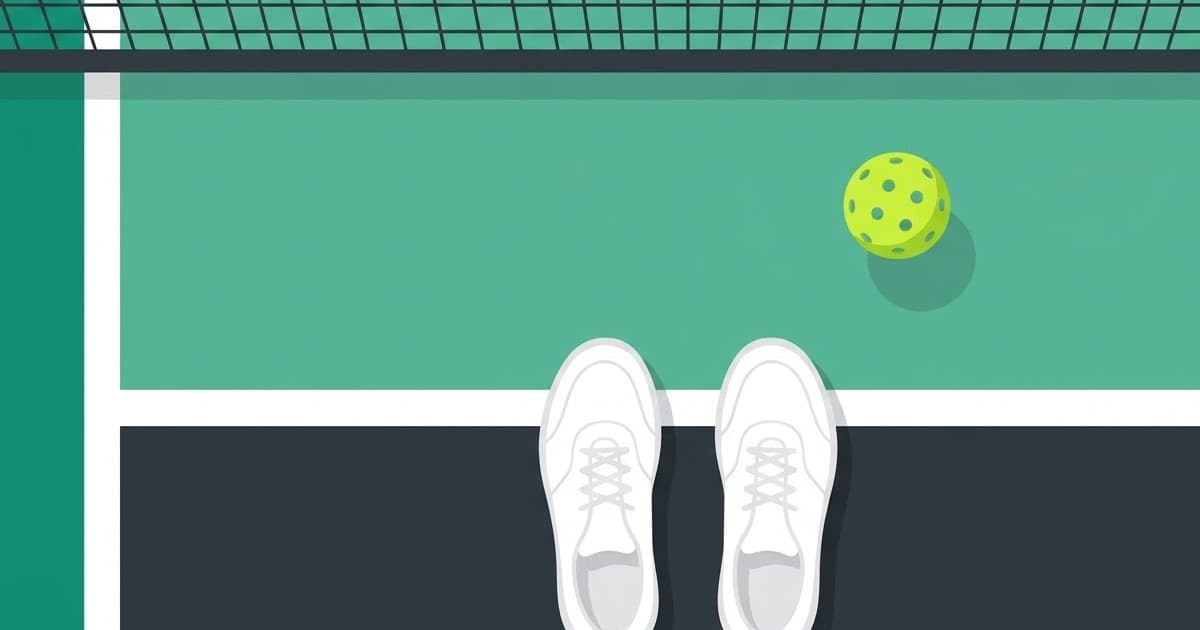
The kitchen is the 7-foot by 20-foot area of the court on each side of the net (3.A.4.c). The kitchen line runs parallel to the net, 7 feet from it, between the two sidelines. Three details are easy to miss:
- The lines around the kitchen are part of the kitchen (3.A.4.c). Touching the line counts as touching the kitchen.
- The kitchen is flat. It does not extend above the playing surface, so your paddle can reach over it as long as you are not touching the zone itself (3.A.4.c).
- It is on both sides of the net. Each side has its own kitchen, and the rule applies to both.
The one rule
The rulebook states it in a single sentence (11.A):
All volleys must be initiated outside of the non-volley zone. A player, or anything in contact with the player, may contact the non-volley zone at any time except during the act of volleying a ball.
To use that, you need two definitions from the rulebook:
- A volley is a strike of the ball before the ball bounces.
- The act of volleying begins when you hit the ball out of the air and ends when your movement from the follow-through (your momentum) stops.
So the question at the kitchen is always: was the ball in the air when I hit it, and was I (or anything touching me) touching the kitchen during the whole act of hitting it, including my follow-through? If yes, it is a fault.
What you CAN do in the kitchen
- Stand in it at any time, as long as you are not volleying (11.A).
- Step in to hit a ball that has already bounced. The rule only applies to volleys (hitting the ball before it bounces), and you may touch the kitchen at any time except during the act of volleying (11.A).
- Hit a bounced ball while standing in it, and stay there afterward. Because contact with the kitchen is only a fault during a volley, you do not have to leave after hitting a ball that has bounced.
- Reach over it. The zone is flat, so reaching over the kitchen to volley a ball is fine, as long as nothing touches the zone.
What you CANNOT do
Section 11 lists three kitchen faults.
1. Touching the kitchen while volleying (11.A.1)
If you volley and you, or anything you are wearing or carrying (your paddle, hat, even your partner who is touching you), touch the kitchen, it is a fault against you. For example, your toe on the line at the moment you hit a ball out of the air is a fault.
2. Momentum into the kitchen (11.A.2)
This is the rule that catches experienced players too. If your momentum from the volley carries you into the kitchen, or into your partner who is touching it, it is a fault, even after the ball becomes dead. The ball can already be out of play, and the fault still stands. The act of volleying only ends when your movement from the follow-through stops, so stay balanced until you have stopped.
3. Volleying again before you have left (11.A.3)
If you touch the kitchen and then volley a ball, both feet must be completely outside the kitchen and on the court surface first. Stepping into the kitchen, then leaning back out and volleying with one foot still touching it, is a fault.
Kitchen scenarios
| Situation | Fault? | Why |
|---|---|---|
| The ball bounces in the kitchen and you step in to hit it | No | A ball that has bounced is not a volley. |
| You stay in the kitchen after hitting a bounced ball | No | There is no fault for staying in the zone after a bounced ball. |
| You volley a ball with your toe on the kitchen line | Yes | The line is part of the kitchen (11.A.1). |
| You volley from behind the line, and your follow-through carries you into the kitchen | Yes | Momentum fault, even if the ball is dead (11.A.2). |
| Your partner stands in the kitchen while you volley, and you do not touch them | No | There is no fault unless you touch them while volleying. |
| You volley and your momentum causes you to touch your partner who is in the kitchen | Yes | Momentum fault (11.A.2). |
| You step into the kitchen, then volley before both feet are fully outside | Yes | Failure to exit first (11.A.3). |
| Your paddle crosses over the kitchen to volley and touches nothing | No | The zone is flat and you did not touch it. |
The kitchen and the serve
The serve has its own kitchen rules:
- A served ball must clear the opponent's kitchen, with or without touching the net, and land in the correct service court (7.E).
- A serve that lands in the kitchen is a fault against the server (7.E.2).
- A serve that lands on the kitchen line is out, because the line is part of the zone (8.C).
For every other shot, a ball that touches a line is in (8.B). The kitchen line is out only for the serve.
Who calls kitchen faults?
You can call a kitchen fault on your opponent. The rulebook only lets players enforce two kinds of faults on opponents: kitchen faults and serving foot faults (9.B.3). The key rules:
- Call it as soon as you see it and before the next serve is hit (9.B.3.a).
- If the two teams disagree about whether a kitchen fault happened, the rally is replayed (9.B.3.b).
- If partners disagree with each other about a fault call, the decision goes to their opponents' benefit (9.B.3.c).
- If you can't be sure, be careful: the spirit of the rules is to give the benefit of the doubt to your opponent.
How to stop making kitchen faults
These are practical habits, not official rules:
- Give yourself a step. Beginners often stand right on the line. If you start one step back, there is more room for your follow-through.
- Let it bounce. If you are not sure whether to volley, let the ball bounce. A bounced ball can be hit from anywhere, including inside the kitchen.
- Hit and recover. Treat each volley at the net as hit-then-stop. Stay balanced until your movement has finished.
- Watch your partner. Remember that touching your partner who is touching the kitchen counts, so avoid colliding at the net.
- Practice the dink. A dink is a soft shot that lands in the opponent's kitchen. It forces opponents to let the ball bounce, and it is the standard way to keep rallies going at the net.
Related guides
- New to the game? Start with my pickleball rules for beginners.
- Confused by the score call? Read pickleball scoring explained.
- Choosing a paddle? See my paddle buying guide.
Sources
- USA Pickleball, Official Rulebook (2026 edition, effective January 1, 2026): Section 2 (definitions of volley, act of volleying and non-volley zone), Section 3 (court specifications), Section 7 (serving), Section 8 (line calls), Section 9 (faults) and Section 11 (non-volley zone infractions).
- USA Pickleball, 2026 Rulebook Change Document, which includes the updated definition of the act of volleying.
Last checked against the 2026 rulebook in October 2026. I will update this guide when USA Pickleball publishes a new edition.
Frequently asked questions
Can you stand in the kitchen in pickleball?
Yes. A player, or anything in contact with the player, may touch the non-volley zone at any time except during the act of volleying a ball. You can walk in, stand in it and wait there for a ball to bounce.
Can you hit a ball that bounces in the kitchen?
Yes. The rule only stops you from volleying, which means hitting the ball before it bounces. You may step into the kitchen to return a ball that has bounced, and you can stay there afterward.
Is the kitchen line part of the kitchen?
Yes. The rulebook says all lines that bound the non-volley zone are part of the zone, so touching the line while you volley is a fault.
What is the momentum rule?
The act of volleying lasts until your movement from the follow-through stops. If your momentum carries you into the kitchen, or into your partner who is touching it, that is a fault, even if the ball is already dead.
Does a serve that lands on the kitchen line count?
No. A serve that lands in the opponent's kitchen, including on the kitchen line, is out and is a fault against the server. For other shots, a ball that touches a line is in.
Who can call a kitchen fault?
Players may call non-volley zone faults on their opponents, and should call them as soon as they are noticed and before the next serve is hit. If the two teams disagree about whether there was a kitchen fault, the rally is replayed.
Keep reading
Pickleball Scoring Explained: How to Keep Score (With Examples)
Confused by “zero-zero-two”? Learn how pickleball scoring works: who scores, the three-number call, server one and two, side outs and singles, step by step.
Pickleball Rules for Beginners: The Simple Guide (2026 Rules)
Learn pickleball in plain English: the court, serving, the two-bounce rule, the kitchen, faults and scoring, based on the 2026 USA Pickleball rulebook.

Best Pickleball Paddles of 2026: How to Choose and Top Picks by Player Type
Which pickleball paddle should you buy? Learn how core, weight and shape change your game, then see 2026 picks by player type from independent tests.